
DD09 • YC Funds Quantum Computing You Can Use From Your Desk
Inside Conductor Quantum, the startup turning 27 years of quantum work into 10 days

// 7 min read · “No way, this can’t be the fastest path!” One Oxford researcher’s frustration became a company. Now quantum is coming to your desk. Full conversation on YouTube!
Quantum computing has a PR problem. It sounds like science fiction, looks like a golden chandelier in photos and most explanations make you feel dumber than when you started.
Quick test: mention quantum computing at a party. Watch how fast people’s eyes glaze over. It’s been hyped into incomprehensibility, everyone has heard of it and yet nobody really gets it.
Even Richard Feynman, one of the greatest physicists of the 20th century, once said
“I think I can safely say that nobody understands quantum mechanics.”
He was right then. Yet here we are, turning that mystery into infrastructure.
Hopefully, that ends today for those reading these lines.
Quantum computing sits at that rare intersection of hype and inevitability. Everyone senses it’s coming, yet few truly understand what’s changing or why.
And the timing couldn’t be more symbolic. 2025 is marking a century since the birth of quantum mechanics. In 2024 quantum computing hit a turning point: the field shifted from growing qubits to stabilizing them. That’s the shift from “look what we built in a lab” to “here’s something you can actually use.”
Every technology starts as a mystery before it becomes maintenance.
Take a look back at the past three years. Quantum computing has moved closer than ever to real-world applications. And when that happens, the money shows up. Alphabet, IBM, Microsoft, and even a few governments are doubling down before someone else does. Rigetti Computing (YC S14) rang the Nasdaq bell in March 2022. Perfect proof the quantum race is leaving the lab and entering Wall Street.
Now the eyes are on Conductor Quantum, a new-generation Y Combinator startup bridging AI and semiconductor-based quantum architectures. Not to power more research papers few read but to build applications people will actually use. To bring quantum computing from cold labs to everyday desks.
Yes, you read that right.
When I pressed Brandon on what that really means, he laughed.
“To clarify,” he said, “We see people accessing quantum computers through the cloud—just like you log into ChatGPT. But the joke is, silicon qubits are so small that you could, in theory, fit a desktop-size dilution refrigerator to house them. I know companies making those fridges… though they might be a bit too noisy to keep at home.”
What Is It, Really?
Most photograph the chandelier. Few see the chip.
That golden spiral you have seen in photos? It is not the computer. It’s a refrigerator. Well, something needs to keep the real processor cold enough to let quantum physics happen.
Here’s the essence: Classical computers process information in bits either 0 or 1. Quantum computers use qubits. A qubit can exist in a combination of the states 0 and 1 thanks to a quantum principle called superposition. Yes, it’s as confusing as it sounds.
But that doesn’t mean it’s literally both 0 and 1 at the same time. Previously, this part had confused me. This points towards the linear combination of states characteristic.
To visualize it, imagine a qubit being a point on a sphere where the north pole is 0 and the south pole is 1.
And when qubits interact through entanglement, their states become linked. Meaning, a change in one instantly affects the others. Einstein had a phrase for it “spooky action at a distance” and he wasn’t wrong.
This gives quantum systems their extraordinary potential: they can explore countless possibilities at once instead of one after another allowing them to find patterns or solutions more efficiently than classical computers for certain problems.
That doesn’t mean they’ll replace classical computers. In fact, they’ll likely be terrible at most everyday tasks.
Follows on from the qubit definition basis. As far as we know quantum computers will only be good at solving quantum problems but painfully slow at something as simple as 2 + 2 = 4.
It’s not just faster, it’s a different kind of speed.
If regular computers are cars, quantum computers are rockets. But you don’t need a rocket to get groceries. Some problems just need better wheels.
That’s why they could revolutionize problems like molecular simulation, optimization, and cryptography. The areas where classical systems hit physical and mathematical limits. And yet, building one is absurdly hard. Each qubit must remain stable long enough to compute before noise collapses it. Imagine balancing a soap bubble in a thunderstorm. That’s Tuesday for a quantum engineer.
That’s why Conductor Quantum’s approach matters. While most teams still handcraft qubits one by one like bespoke suits. The team is using AI to automate that process of designing and validating them a thousand times faster. Imagine what that means: medicines discovered in months, clean energy breakthroughs that suddenly feel within reach.
A useful quantum computer needs 1,000,000 qubits.
Manual configuration: 27 years.
Conductor Quantum’s goal: 2 minutes.
Ambitious would be an understatement.
As Brandon put it:
“We’d tune up the one million qubits in parallel so it wouldn’t take too long—we want it to feel like the boot time of a laptop. I’ve seen some back-of-the-envelope calculations for manual configurations coming in at a hundred years.”
He laughs as he says it, but the point is serious.
Why Now
For years, quantum was defined by papers, not products. Now AI is stepping in and changing everything.
The moment machine learning began accelerating qubit design, the field shifted from Wright brothers’ gliders to Boeing’s factory floor.
The question changed, too. We stopped asking “Can we make qubits?” and started asking “Can we control thousands of them fast enough?”
That’s not a physics problem. It’s a software problem. And software problems scale.
Which means the next leap in quantum won’t come from colder labs, it will come from smarter code.
That’s when quantum gets real.

The Realization
“The impediment to action advances action. What stands in the way becomes the way.” – Marcus Aurelius
After finishing a months-long quantum hardware assignment, Brandon caught himself saying, “No way! This can’t be the fastest path.” That thought wouldn’t leave him.
He’d spent his PhD at Oxford publishing papers in Nature on quantum device control. But credentials weren’t the breakthrough, the realization was.
The bottleneck was obvious once he saw it: building qubits by hand doesn’t scale. Quantum engineers spend days, sometimes weeks, configuring silicon chips just to create one qubit. But we’ll need millions maybe billions to make quantum computers truly useful.
So the Conductor Quantum team made a bold bet: use intelligence to build intelligence.
If this works, every researcher, every startup, maybe even every student could access a quantum computer from their desk.
If quantum doesn’t scale in the next decade, we’ll hit computational walls in drug discovery and climate modeling that money can’t solve.
What’s Taking So Long?
This is one of my favorite moments from our conversation. Brandon recently called his mother to check in. She asked: “Have you solved that quantum computing problem yet?”
“Not yet, Mom.”
“What’s taking so long?”
The question wasn’t wrong, it was just early.
And honestly, it’s the kind of question every founder should keep close.
Five years ago, this was still a moonshot. Today, it’s hard engineering. Hardware matured enough that the bottleneck shifted from fabrication to orchestration.
AI is now essential for quantum to scale, and this is exactly the moment to tackle it.
When I sat down with Brandon, he said something that stuck with me:
“If quantum is going to scale, it can’t depend on PhDs tuning each qubit. It has to be software-defined.”
That single line might age the way “software is eating the world” did for classical computing.
The next decade of quantum will be defined not by new physics but by industrialization, how to automate, abstract and scale what was once artisanal.
Conductor Quantum’s work is a case study in that transition: turning the craft of qubit-making into a repeatable, learnable process.
Conviction
Brandon calls this his life’s work, not because it’s easy but because it’s inevitable.
Every founder says they have conviction. Few mean it as literally as he does. He runs the company with what he calls a “sharp knife” of focus: one official team meeting per sprint, zero distraction from the mission. Sharpening the knife one sprint at a time.
He’s 100% committed to making this work and doesn’t want to pursue anything else. He knows the field inside and out through his PhD and postdoc. He feels this is his moment to leave a dent in the planet. The reason to wake up with hope every morning.
What strikes me most is his mission to educate. Brandon believes it’s a founder’s job to spread new perspectives, which is why we’re having this conversation in the first place. He’s eloquent, humble and remarkably optimistic about what’s possible when you pair conviction with clarity.
His co-founder Joel Pendleton is the archetype of the restless builder who leaves academia to build what academia couldn’t.
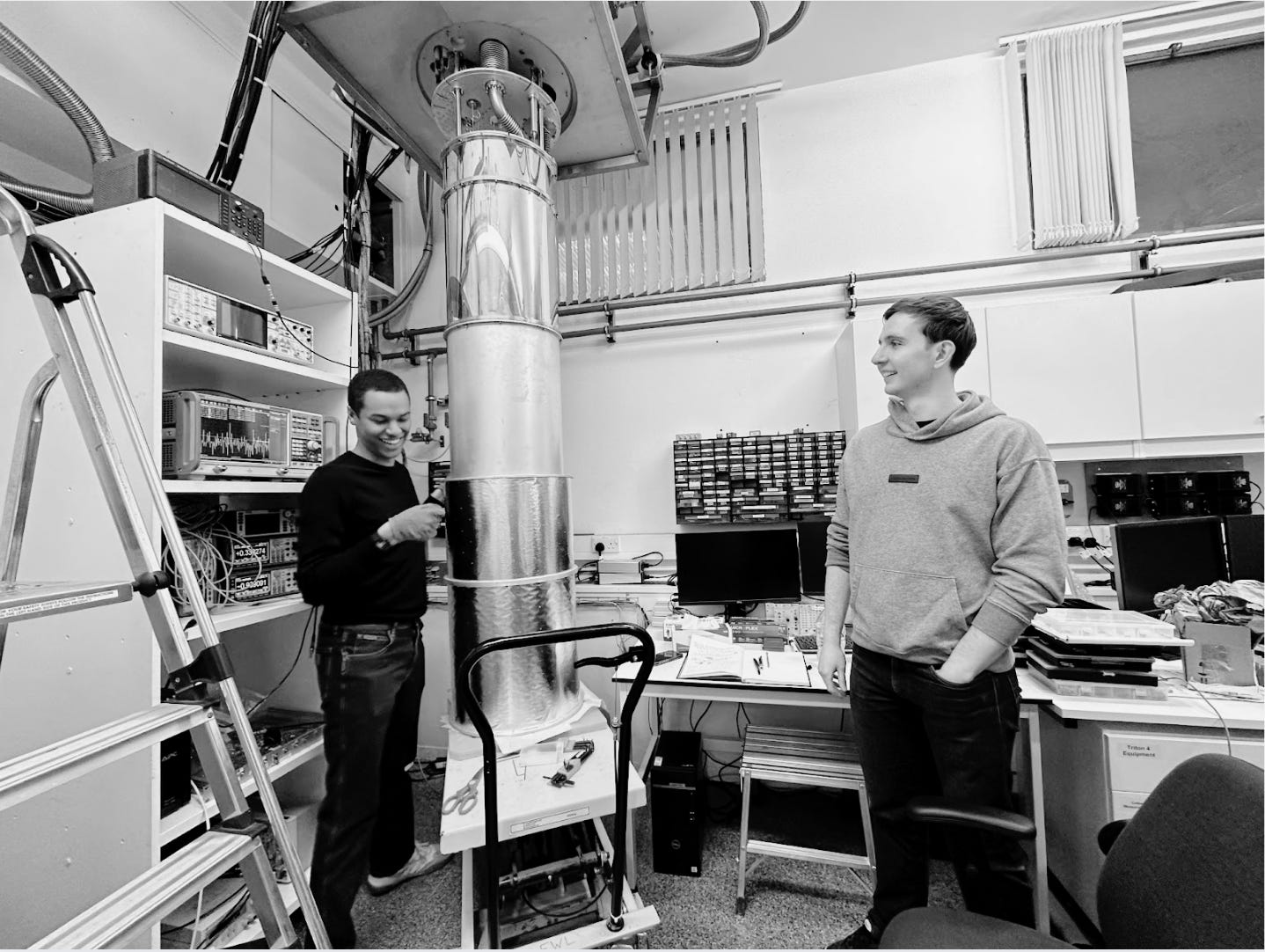
Joel spent years inside the world’s most experimental labs, moving between deep-tech startups and quantum research groups, exploring everything from carbon nanotubes to superconducting qubits. Halfway through his PhD at Oxford, he made a decision: stop researching, start building. That “yes” to Brandon became Conductor Quantum. A different kind of marriage, you could say.
Together, they are building the infrastructure layer that will make quantum computing feel ordinary. And that’s when revolutions happen, when the astonishing becomes routine.
Quantum isn’t a bubble. It’s the next wave of compute.
We just don’t recognize infrastructure when it’s still cold and quiet.
The next time you see that golden chandelier, remember: the real magic isn’t the light. It’s the silence below, where the future of computing hums at a fraction of a degree above absolute zero.
It’s not a question of if but when.
Our full conversation with Brandon drops on YouTube soon. It’s worth your time. I promise.
Until next time,
Nihal
––
Thanks to Brandon Severin, co-founder of Conductor Quantum for the thoughtful edits on this piece and for peppering his insights with just the right mix of quantum hardware and humor.
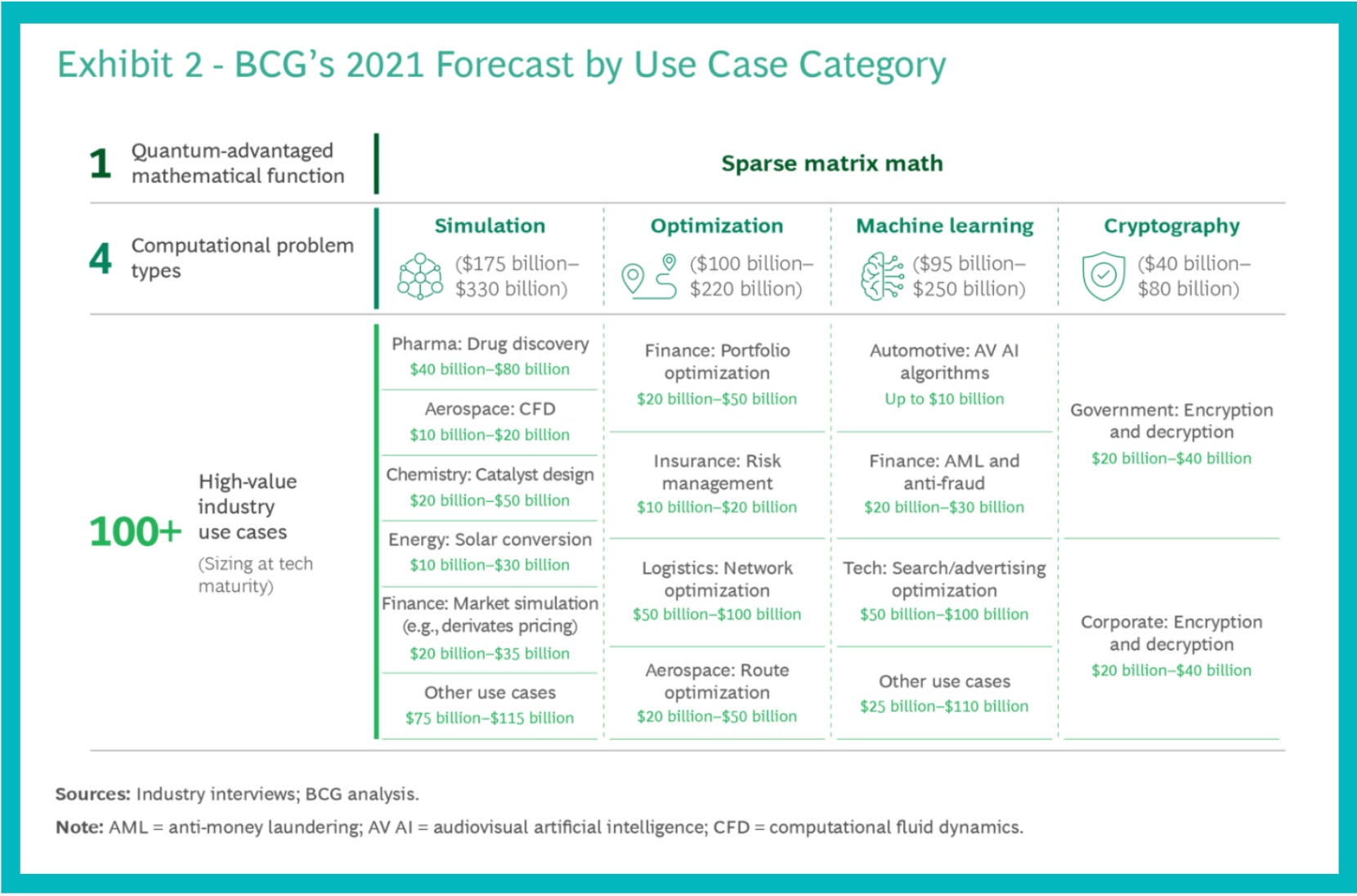
Market Context:
BCG forecasts quantum computing will unlock over 100 high-value use cases across industries with simulation alone generating up to $330 billion in value.
The best breakthroughs come when software meets hard science.
Thanks for writing this, it clarifies a lot. This truely hits the nail on the head. That 'PR problem' description is so accurate. I totally agree that the shift from growing qubits to stabilizing them is the real game-changer. Finally, something tangible.